
Beyond the Buzzwords: 3 Paradoxes Holding Back Real AI Skilling
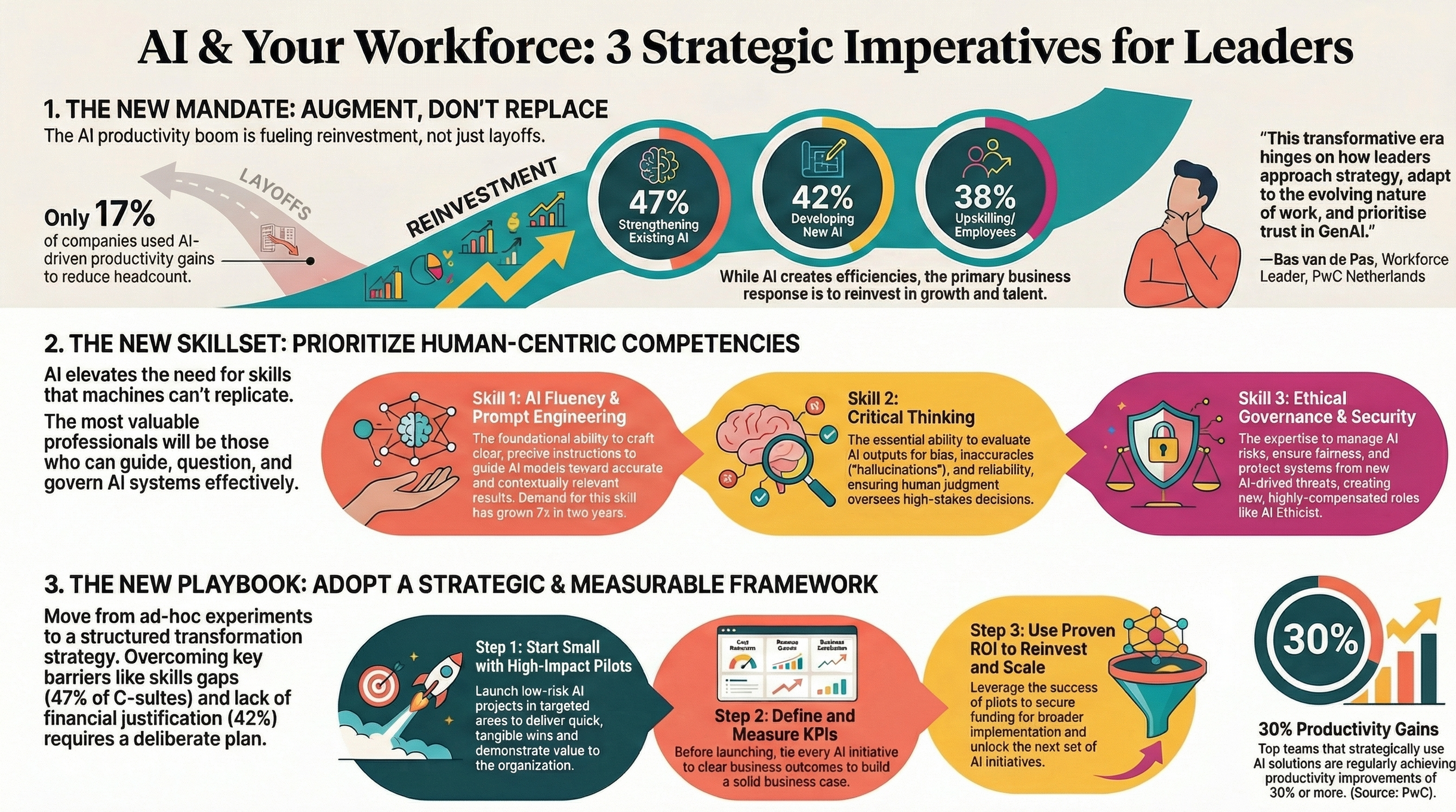
Three Strategic imperatives that Leaders should know
The narrative around AI and the workforce is well-rehearsed: AI is transforming every industry, and employees must urgently upskill to stay relevant. This story is true, but it misses the point. The real, untold story isn't the need for skills, but the surprising and systemic failure to build them effectively, even inside the most successful AI-adopting companies. While leaders acknowledge the skills gap, their actions - or lack thereof - reveal a deep disconnect between awareness and execution. This failure isn't random; it's a pattern defined by three core paradoxes. The true measure of leadership in the AI revolution will not be the speed of technological adoption, but the courage to fundamentally re-architect the relationship between human talent and intelligent machines.
--------------------------------------------------------------------------------
1. The Reinvestment Paradox: We're Buying More AI, Not Better Humans
The first paradox of the AI era is one of misplaced investment. Companies are reaping historic productivity gains, but instead of building a more capable workforce, they are simply buying more capable machines. An EY survey confirms that fears of mass layoffs are largely unfounded, with only 17% of organizations with AI-driven productivity gains reducing their headcount. The vast majority are channeling those gains back into the business, but their priorities are telling. Far more companies reinvested in strengthening existing AI capabilities (47%) and developing new ones (42%) than in upskilling the employees who must wield these tools (38%).
This tech-first reinvestment strategy is not an accident; it's a symptom of legacy capital allocation models. Technology is a tangible asset with a predictable depreciation schedule, making it an easy sell to a CFO. In contrast, human upskilling is often miscategorized as a discretionary operational expense with harder-to-measure, long-term ROI. The paradox reveals that companies are still more comfortable managing predictable assets than they are at cultivating adaptable talent. This is a strategic miscalculation, locking organizations into a "productivity mindset" focused on optimizing today's operations at the expense of a "growth agenda" built on innovation.
As Dan Diasio, EY Global Consulting AI Leader, argues, this is the critical distinction between optimization and true transformation:
Organizations that shift from a productivity mindset to a growth agenda are using AI to drive innovation, create new markets and achieve what was previously considered impossible.
--------------------------------------------------------------------------------
2. The Executive 'Knowing-Doing' Gap: Awareness Isn't Action
This preference for technology over talent - the Reinvestment Paradox - is enabled by a deeper failure at the leadership level: a systemic gap between knowing what's necessary and doing what's required. The C-suite is fully aware of the skilling imperative, but this awareness has failed to translate into meaningful action. The data paints a clear picture of this executive paralysis.
Consider these figures:
A BCG study found that while 89% of executives say their workforce needs improved AI skills, a mere 6% reported they had begun upskilling in "a meaningful way."
PwC’s CEO Survey shows leaders plan to integrate AI into their technology platforms (47%) and core business processes (41%) at a much higher rate than into their workforce and skills (31%).
A Gallup poll reveals the consequences of this inaction: only 2% of Chief Human Resources Officers strongly agree that their current upskilling initiatives are cultivating the skills employees will actually need in the future.
This isn't mere negligence; it's a structural failure. The gap persists because accountability for AI skilling is fatally diffused. While the CEO acknowledges the need, the CHRO lacks the budget, the CFO questions the immediate ROI, and the CIO is focused on platform deployment. Without a single, empowered owner of the AI talent transformation agenda, awareness will never translate to action.
--------------------------------------------------------------------------------
3. The "Human-in-the-Loop" Fallacy: The Most Critical AI Skill Isn't About AI
The final paradox challenges the very definition of "AI skills." The common understanding of "human-in-the-loop" is a fallacy. It implies a passive, reactive role of simple verification. The reality is that the most critical human role is proactive and generative: applying contextual judgment, anticipating biases, and shaping the strategic application of AI, tasks the machine cannot even comprehend.
While technical competencies like prompt engineering are important, they are merely the entry point. Generative AI’s core limitation is its inability to understand context, which leads to "hallucinations" - outputs that are factually inaccurate or nonsensical. The crucial skill is not just crafting a good prompt, but critically evaluating the AI's response for reliability, bias, and contextual appropriateness. A human must always be in the loop to ask: Is this output correct? Is it appropriate for this situation? Does it reflect an unseen bias in the data? This elevates critical thinking to the most essential and durable soft skill of the AI era, ensuring that we guide the machine, not blindly follow it.
Dr. Mark Esposito of Harvard DCE pinpoints the fundamental limitation that makes human judgment indispensable:
One of the major limitations with generative AI is that we as humans, understand context very easily, but the machine will not be able to generate context.
--------------------------------------------------------------------------------
Conclusion: Are You Buying AI or Building an AI-Ready Culture?
The path to AI maturity is defined by a choice between two futures. One path leads to becoming a powerful but brittle "AI-tool operator," dependent on the next software update and vulnerable to its inherent blind spots. The other leads to becoming a resilient, innovative "AI-ready culture," where technology amplifies human judgment, not replaces it.
The paradoxes of reinvestment, executive inaction, and misunderstood skills reveal that the primary challenge is not technological adoption but strategic, human-centric transformation. This presents the ultimate ultimatum for every leader:
Is your organization just buying AI tools, or is it building the critical human judgment needed to wield them wisely?
