5 Surprising AI Truths Every Manager Needs to Hear
Introduction: From AI Curiosity to AI Leadership
Most professionals today have a similar story: you’ve experimented with AI tools like ChatGPT, you see the potential, but you’re not sure how to move from casual use to strategic implementation for your team. There’s a persistent, nagging feeling that you might get "left behind" as the world rushes forward.
This article is designed to bridge that gap. It shares five counter-intuitive but critical mindset shifts required for effective leadership in the AI era. These aren't just theories; they are the core principles that experts are teaching the next wave of AI-savvy managers, moving them from passive observers to active, strategic leaders.
1. The Biggest Hurdle Isn't Technical—It's Leadership
A common misconception is that leading in the age of AI requires a deep technical background in coding or data science. The reality is that the most significant challenge isn't mastering the technology; it's mastering the leadership required to deploy it effectively.
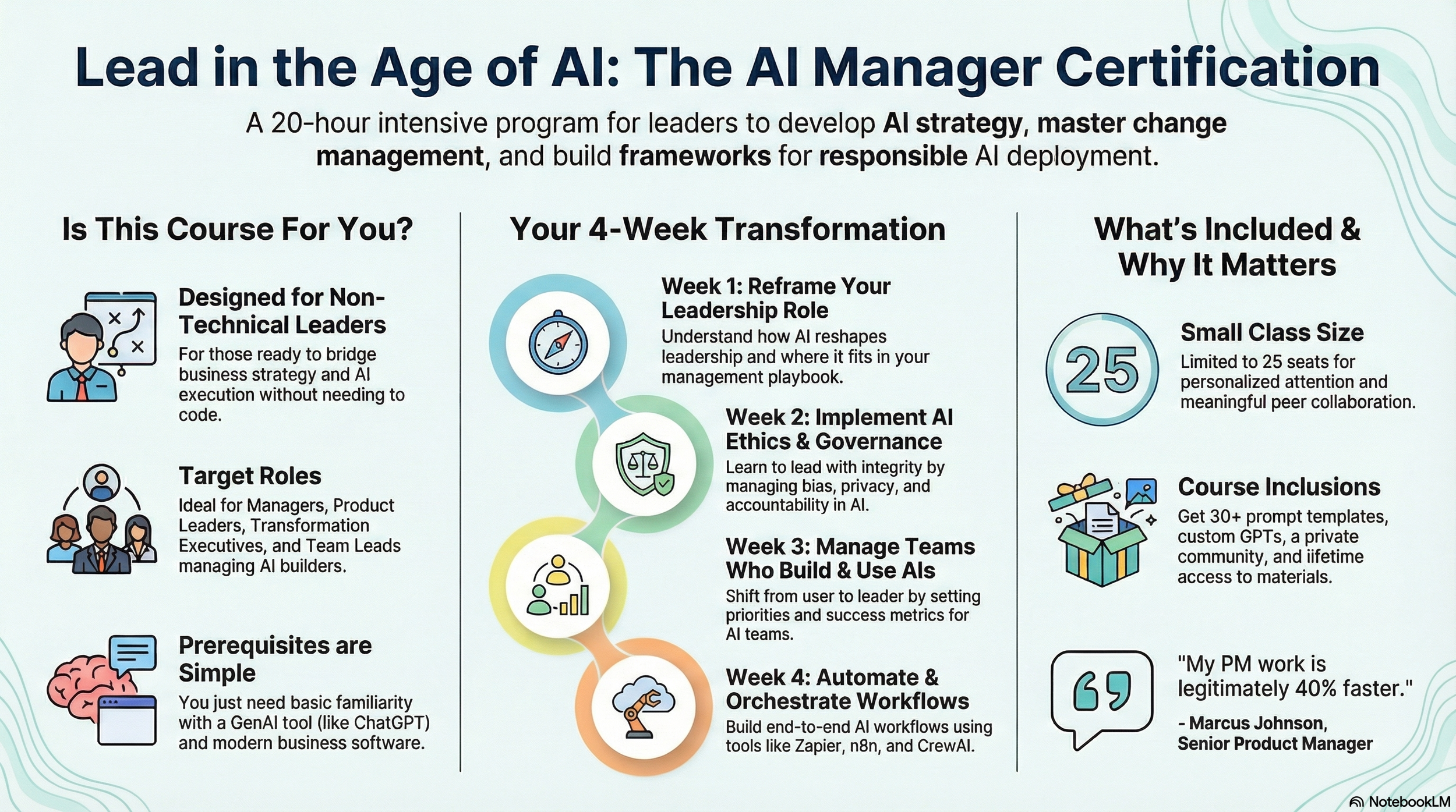
The real work lies in guiding people, managing organizational change, and ensuring ethical implementation. This is why specialized programs are explicitly designed for non-technical professionals—not just managers, but Product and Program Leaders, Transformation and Innovation Executives, and Business Analysts, Data, and Tech-Adjacent Professionals. The only prerequisites are a basic familiarity with a tool like ChatGPT and a "managerial or leadership context" to connect AI's capabilities to your team's goals. The focus is on strategy, people, and orchestrating work with modern tools, not programming.
2. Your AI Is More Than a Tool—It's a Thinking Partner
It’s time to stop viewing AI as a glorified search engine or a simple automation bot. The most effective leaders are learning to treat it as an essential partner for complex problem-solving and strategic thinking. This involves a fundamental shift from giving it simple commands to engaging it in a collaborative dialogue.
A key technique for this is developing a "Personal Operating Profile (POP)," a method to train an AI assistant to adopt your specific strategic priorities. By doing this, the AI transforms from a generic tool into a personalized collaborator that understands your context. For instance, it can learn to generate emails with the same tone, same level of detail, and same communication style you use, to the point where your own team can't tell the difference. As Marketing Director Shomaila K. discovered:
"I used to think ChatGPT was just a glorified search engine. Now I literally talk to it about my strategic challenges and it helps me think through complex problems. It's become an essential thinking partner."
3. The Gains Are Not Far-Off Promises—They're Immediate Productivity Boosts
While many conversations about AI focus on futuristic, large-scale transformation, the most significant initial returns are often found in immediate, tangible workflow efficiencies. Strategic AI use isn't about waiting for a hypothetical future; it's about reclaiming hours in your workweek right now.
The evidence is clear and measurable. Senior Product Manager, Marcus Johnson, found that after integrating AI into his daily tasks like meeting prep, documentation, stakeholder updates, and competitive analysis, his work became "legitimately 40% faster," freeing him up for more high-value strategic thinking. Similarly, Scrum Master Sarah Chen built a custom GPT to analyze sprint retrospectives. The result? It saves her "3 hours every single sprint," and the insights it delivers are "genuinely better" than what she could produce through manual analysis alone.
4. True AI Readiness Puts Ethics and Governance First
Moving from casual, individual experimentation with AI to professional, team-wide deployment requires a formal framework for responsible use. Simply encouraging your team to "use AI" without structure is a recipe for risk. True AI readiness means putting ethics and governance at the forefront of your strategy.
Dedicated training for AI-enabled managers focuses heavily on this, covering critical topics like bias, transparency, and accountability. The goal is to build "Guardrails by design" by establishing a "Responsible AI Charter." In practice, this means that controls are built into your AI lifecycle, not bolted on later. Core components include access controls, evaluation harnesses, audit trails, and red-team testing, ensuring compliance becomes an automatic part of daily work, not an afterthought.
5. AI Fluency Is Rapidly Becoming Your Career's Table Stakes
The pace of change is undeniable. AI adoption is "accelerating faster than any technology in history," and companies are "actively seeking" professionals who can do more than just use AI—they need leaders who can leverage it strategically. This urgency is precisely why the ROI on developing these skills is so high, with reports showing 95% of learners achieve a key professional goal after formal training.
What was once a "nice-to-have" skill on a resume is quickly becoming a fundamental expectation. Developing AI fluency is no longer about gaining a slight edge; it's about positioning yourself to be "indispensable tomorrow." This sentiment was perfectly captured by Javeed Kadri, a Senior Scrum Master, who reframed his entire outlook on professional development:
“From the fear of AI, I have started believing that AI can be used as a creative partner… My future-proofing goal is to become someone who can use AI.”
Conclusion: Are You Ready to Lead the Change?
Leading in the age of AI is proving to be less about mastering the machine and more about refining our most essential human skills: strategic thinking, ethical judgment, and effective change management. The technology is a powerful amplifier, but it still requires a clear, confident, and responsible leader to direct its power toward meaningful goals.
AI is ready to be a powerful force multiplier for your team. The only question is, are you ready to lead it?
