
1. Introduction: The Activity Illusion
You’re drowning in tasks. Your calendar is a back-to-back wall of meetings, your dashboards are filled with charts tilting upwards, and your team is constantly shipping features. You are undeniably busy. Yet, a nagging feeling persists: is all this motion translating into meaningful progress? This is the activity illusion, a modern professional trap where we mistake the volume of our work for the value it creates. We are working harder than ever but feel like we're getting nowhere.
If this sounds familiar, you're not alone. The solution lies in a fundamental shift of perspective: from celebrating activity to validating impact. The following five revelations are not just isolated tips; they are a connected set of mental models that build on one another, from diagnosing the problem to redesigning your team's entire approach to work.
2. The 5 Revelations
2.1. 1. You’re Trapped Measuring Activity, Not Impact
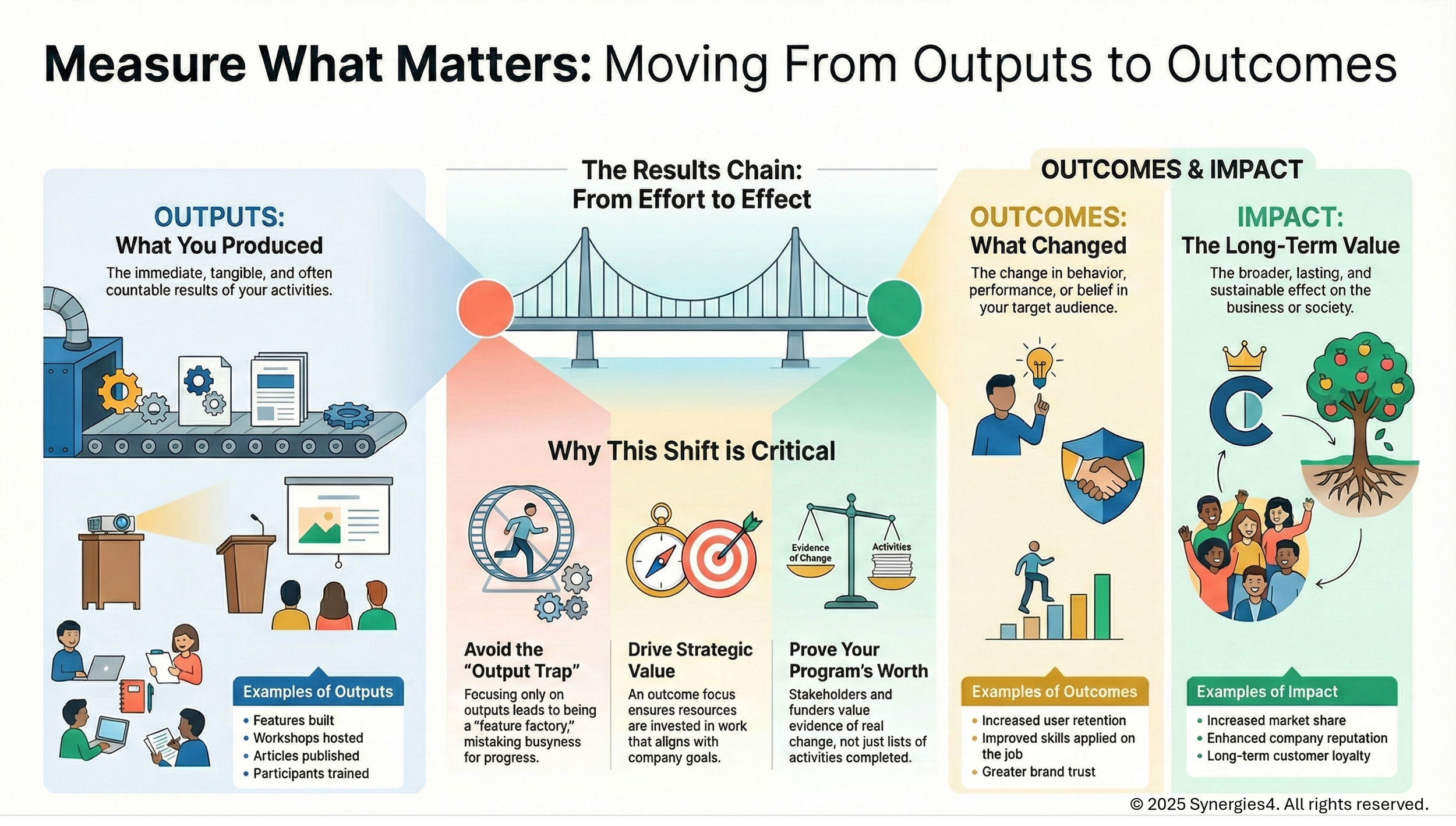
The most fundamental mistake organizations make is confusing outputs with outcomes and impact. Outputs are the immediate, tangible results of your activities—the features shipped, the reports written, the workshops hosted. They are easy to count and feel productive. Outcomes, however, are the meaningful changes in behavior or performance that your outputs create for your audience. And impact is the ultimate business result—the change in sales, talent attraction, or brand reputation.
This confusion leads to the "Output Trap," where teams operate like "feature factories," churning out features and deliverables without considering if they generate any real added value for the customer. This trap is common because outputs are simply easier to measure than the real-world changes they are supposed to drive. But focusing only on what’s easy to count leads to celebrating motion over progress.
"Simply put, outputs show you were busy, outcomes show you were effective and impact demonstrates where and how you mattered."
2.2. 2. Your Expertise Can Be Your Biggest Blind Spot
It seems counter-intuitive, but sometimes the person with the most expertise can be the biggest barrier to progress. This is the "Expert Trap," a dynamic where a leader or key worker dictates solutions and plans without first engaging the team or client to determine their own goals. While done with the best of intentions, this approach often promotes passivity and disengagement. This "Expert Trap" is one of several well-documented leadership behaviors, like the "Premature Focus Trap," that inadvertently stifle the very engagement needed to achieve meaningful outcomes.
When the expert provides all the answers (an output-focused action), stakeholders may half-heartedly commit to the work because the plan isn't theirs. This principle applies far beyond counseling sessions; it’s a critical lesson in business leadership and product management. By dictating "what you should do," leaders inadvertently sabotage the very commitment and active engagement (the desired outcome) needed for change to occur.
2.3. 3. The Secret Is to Start at the End
To escape the activity illusion, you need a powerful mental shift. Instead of starting by asking, "What should we do?" begin by asking, "What outcome do we want to achieve?" This simple re-framing forces you to define success before any work begins, ensuring every action is aligned with a clear, valuable goal.
A practical way to implement this is with the "OUTCOMES → OUTPUTS → OBSTACLES" framework. First, you start by defining the measurable business outcome with stakeholders. Only then do you work backward to identify the key work outputs—the tangible deliverables—that will lead to that outcome. Finally, you diagnose the obstacles preventing your team from creating those outputs effectively. This model ensures that you are enabling performance, not just launching another initiative into the void.
"If we’re not improving the performance of the target audience, why bother?"
2.4. 4. The Simple Act of Tracking Can Spark Real Change
Here is a surprising and powerful secret: rigorous studies have shown that the mere attempt to track activities can, by itself, create a positive impact. You don’t need a perfect measurement system from day one. Simply beginning the process of observation is often enough to spark improvement.
A classic example is weight loss. Studies have proven that just tracking calories consumed results in weight loss that is attributable to the tracking itself, regardless of the specific diet or exercise plan followed. This is an incredibly freeing concept. It removes the pressure for perfection and proves that simply paying attention to what you are doing is a powerful first step. For any leader, this is a call to action: begin the work of measurement, even imperfectly, because the act of observation itself is often the catalyst for improvement.
2.5. 5. Your Dashboard Might Be a Hall of Mirrors
Automated dashboards are powerful tools, but they can also be dangerous. They are excellent at collecting, sorting, and visualizing data, especially outputs like media mentions, site visits, and social media likes. The trap is that we, as leaders, often read these output metrics as if they are direct proof of outcomes, collapsing the difference between activity and success.
Imagine a sustainability campaign. The dashboard might show 150 media mentions and 10,000 likes—a clear win by output measures. But an outcome analysis might reveal that audience trust scores remained flat and only 10% of the target audience recalled the core message. The Schrödinger's Cat thought experiment offers a useful analogy: until you "open the box" with direct evidence of audience perception and behavior change, you are only observing possibilities, not reality. Your shiny dashboard might be showing you a hall of mirrors, reflecting activity without confirming actual impact.
3. Conclusion: From Motion to Meaning
Ultimately, moving from motion to meaning transforms a team's culture from one of frantic box-ticking to one of focused inquiry and validated success. It's the difference between asking "What did we ship?" and asking "What did we change?" This is a fundamental shift from an "output mindset" that celebrates activity to an "outcome mindset" that celebrates meaningful change.
As you reflect on your own work, ask yourself this one powerful question: What is the one outcome that, if you achieved it, would change everything for your team—and how would you know you were successful?
