
From Prompting to Fluency: Mastering Your AI Partnership
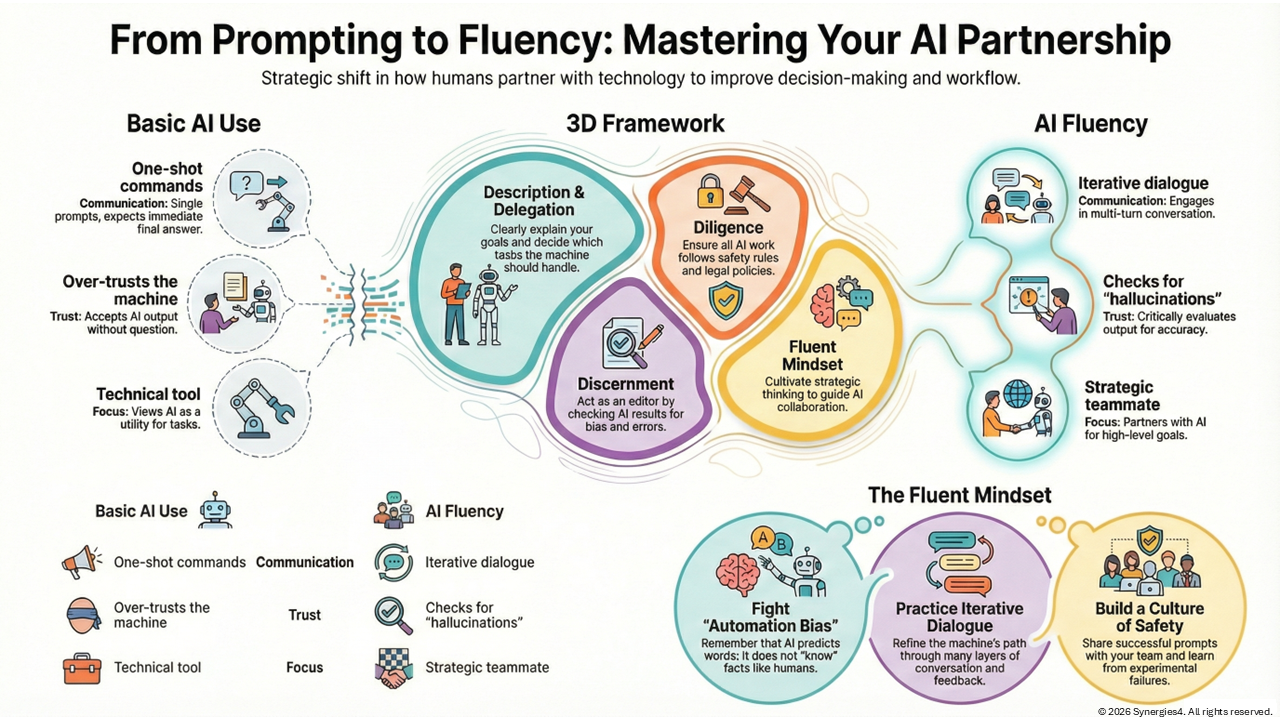
Mastering Your AI Partnership
For the modern executive, the initial novelty of generative AI has rapidly given way to a more pressing realization: there is a profound chasm between "using" AI and being fluent in it - AI literacy vs AI fluency. While millions can generate a superficial email or a generic image, very few have mastered the technology as a strategic lever. In the boardroom, this isn't a technical upgrade, it’s a wholesale reallocation of intellectual capital.
The gap between superficial use and true fluency is where competitive advantage is won or lost. AI fluency is not a checkbox on a training memo; it is a strategic and cognitive shift in the human-technology partnership. It requires moving beyond treating AI as a glorified search engine and instead integrating it as a core component of your decision-making architecture.
The 4D Framework: Master the Art of AI Partnership
To navigate this shift, leaders must look beyond "knowing the buttons" and focus on high-level cognitive competencies. A widely recognized framework, supported by the AI research lab Anthropic, identifies four critical dimensions of fluency that transform AI from a tool into a teammate:
• Delegation: The strategic capability to audit your workflow and decide which components are ripe for machine optimization and which require the irreplaceable nuance of human judgment.
• Description: The discipline of translating human intent into machine-executable context. This is the bridge between a vague idea and a high-fidelity output.
• Discernment: The critical "editorial" layer. It is the ability to interrogate AI outputs for bias, accuracy, and strategic alignment rather than treating the machine as an infallible oracle.
• Diligence: The commitment to accountability. This ensures that every AI-enhanced output remains ethically sound, safe, and compliant with the shifting landscape of corporate and legal policy.
"Growing AI fluency involves more than just technical training; it is a strategic and cognitive shift in how humans partner with technology."
The "Description" Discipline: More Than Just Talking to Machines
In the realm of practical application, "Description" is the skill that separates the amateur from the expert. While often minimized as "prompt engineering," this is actually a sophisticated communication asset. It is the art of defining the "why," the "how," and the "who" for the machine.
From Monologue to Dialogue: True description is rarely a "one-shot" event. It is an iterative dialogue where the human refines the machine’s path through successive layers of feedback. By treating AI as a conversational partner, you move from basic commands to complex collaborative efforts.
Contextual Architecture: Fluency means providing the machine with constraints and intent. Whether you are summarizing high-stakes reports or drafting multi-channel content, the quality of the result is directly proportional to the clarity of your description.
Scrutinizing Intent: When you view communication as a strategic asset, you realize that the AI is only as effective as the context you provide. Mastering this allows you to turn a generic model into a specialized engine tailored to your specific business logic.
Fighting Automation Bias: The Power of Discernment
The most dangerous pitfall in the AI era is "automation bias" - the psychological tendency to over-trust automated systems. To mitigate this, a fluent professional must maintain a rigorous mental model of how these systems actually function.
Discernment is an architectural necessity because of the probabilistic nature of Large Language Models (LLMs). These systems do not "know" facts in the human sense; they are predicting the next most likely word in a sequence based on statistical patterns. Because they are engines of probability rather than engines of truth, they can and will hallucinate with total confidence.
Fluency means never accepting an output at face value. It requires a permanent "editor-in-chief" mindset, where discernment is used to spot subtle biases and factual errors. You aren't just fact-checking; you are exercising the cognitive flexibility to know when the machine has veered off the rails of your strategic goals.
The Architecture of Safe Failure
Individual skill is only half the battle; true fluency must be woven into the fabric of the organization. This requires a shift from "gatekeeping" to "enablement," moving away from one-off workshops toward a culture of continuous reinforcement.
• Safe Experimentation: Leaders must provide "vetted" tools and environments that are safe to fail. This allows teams to push the boundaries of AI without risking the "shadow AI" traps that lead to data security breaches.
• Shared Intelligence: True organizational strength comes from "shared libraries" and internal forums like COPs. When one employee masters a complex workflow for report summarization, that "Description" should become a reusable asset for the entire firm.
• The Fail-Fast Mindset: We must embrace a growth mindset that treats "bad prompts" as data points rather than failures. In the AI journey, experimentation is the only path to mastery. “Do. Or do not. There is no try!” according to Yoda.
Conclusion: The Journey Toward Cognitive Flexibility
The ultimate goal of AI fluency is cognitive flexibility - the ability to oscillate seamlessly between high-level strategy and the low-level execution of a prompt. It is about knowing the "why" of the business goal as clearly as the "how" of the machine interaction.
The transition to an AI-fluent workforce is not a destination, but a continuous evolution. As the technology grows more capable, the human role becomes more about the "4Ds" and less about the manual labour.
Which high-impact task will you "Describe" to your AI partner tomorrow, and where will you draw the line of "Discernment" to ensure the final result is uniquely yours? Exercise your human-in-the-loop.
